The Axiom-4 mission, a landmark private spaceflight jointly executed by NASA, SpaceX, and Axiom Space, successfully launched from Kennedy Space Center on Wednesday, embarking on a meticulously choreographed 28-hour journey to the International Space Station (ISS).
The SpaceX Falcon 9 rocket lifted off at 12:01 PM IST, carrying the Dragon C-213 spacecraft and a four-member crew, including Indian Air Force Group Captain Shubhanshu Shukla. The mission marks India’s return to human spaceflight after more than four decades, with Shukla becoming the first Indian to reach the ISS.
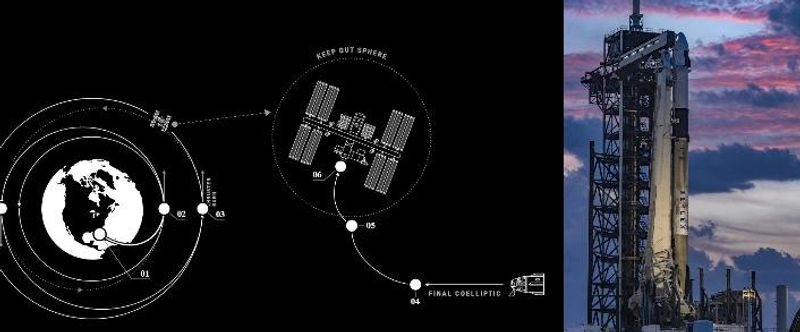
Ten minutes after launch, the Dragon capsule separated from the Falcon’s second stage at an altitude of 260 km and began its orbital ballet. Over the next 28 hours, the spacecraft will perform a series of phasing burns—precise thruster maneuvers to gradually raise its orbit and align with the ISS, which orbits at approximately 415 km above Earth.
The flight path includes multiple key stages:
- Orbit Activation: Initial system checks for propulsion, life support, and thermal control.
- Phasing Burns: Incremental speed and altitude adjustments to synchronize with the ISS.
- Approach Initiation: Establishing communication and final orbit raising.
- Proximity Operations: Autonomous navigation to the docking axis.
- Docking and Pressurization: Final approach to the Harmony module, followed by vestibule pressurization and crew ingress.
Docking is scheduled for 4:30 PM IST on June 26. NASA astronauts Anne McClain and Nichole Ayers will monitor the automated rendezvous from aboard the ISS.
The Axiom-4 crew—led by veteran astronaut Peggy Whitson and including Polish scientist Sławosz Uznański-Wiśniewski and Hungarian engineer Tibor Kapu—will spend 14 days on the ISS conducting over 60 scientific experiments. These range from microgravity’s effects on human physiology to crop seed resilience and stem cell behavior.
Shukla’s role as pilot includes overseeing automated systems, managing contingencies, and coordinating with mission control. His participation is also seen as a precursor to India’s Gaganyaan human spaceflight program, slated for 2027.
The mission underscores the growing role of international collaboration and private enterprise in space exploration, with India, Poland, and Hungary all marking historic returns to human spaceflight.